Table of Contents8 sections
Spain's corporate valuation landscape operates within a sophisticated regulatory framework that balances local accounting traditions with international best practices. At the heart of this system lies the Spanish Association of Accounting and Business Administration (Asociación Española de Contabilidad y Administración de Empresas, or AECA), whose technical pronouncements have shaped valuation methodology across the Iberian Peninsula for over four decades. For professionals engaged in cross-border transactions, financial reporting, or litigation support involving Spanish entities, understanding AECA's valuation standards and their relationship to the International Valuation Standards Council (IVSC) framework is not merely academic—it's essential for credible, defensible work.
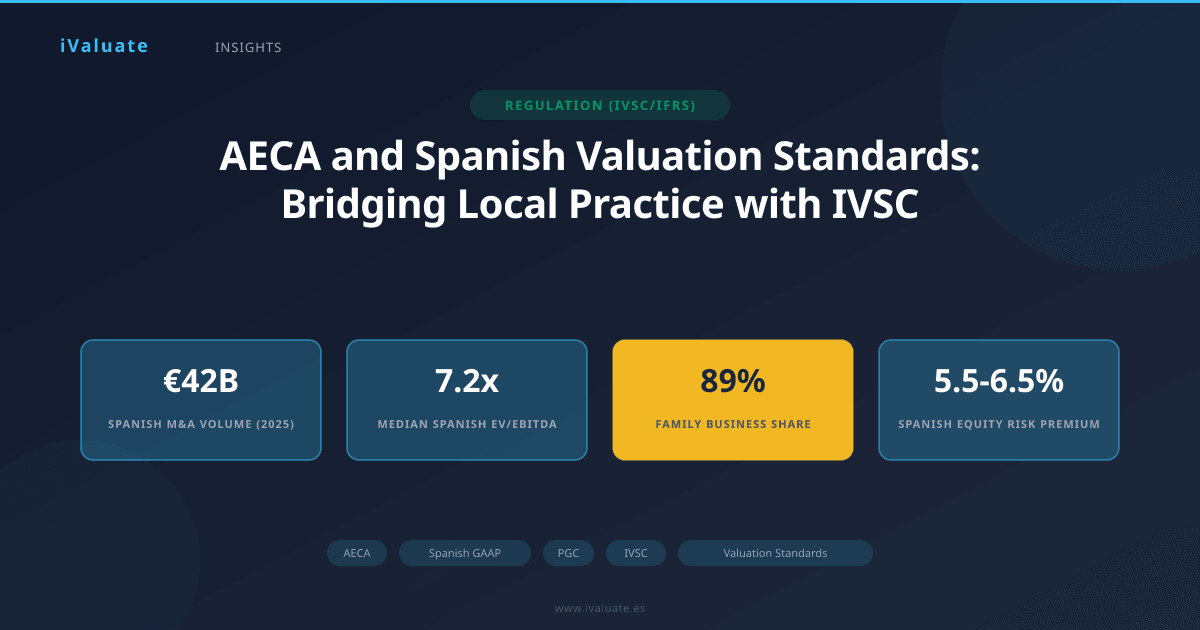
As of 2025, Spain's economy has demonstrated remarkable resilience, with GDP growth stabilizing at 2.3% and M&A activity in the mid-market segment reaching €42 billion annually. This environment has placed renewed emphasis on valuation rigor, particularly as Spanish companies increasingly participate in pan-European consolidation and private equity funds deploy capital across Southern European markets. The convergence of Spanish valuation practice with international standards has accelerated, yet important distinctions remain that can materially impact valuation conclusions.
01 The AECA Framework: Origins and Authority
Founded in 1979, AECA emerged as Spain's preeminent professional body for accounting and financial management, filling a critical gap in technical guidance during the country's transition to a modern market economy. Unlike statutory bodies with regulatory enforcement powers, AECA operates as a technical authority whose pronouncements carry significant professional weight through widespread adoption by practitioners, courts, and regulatory agencies.
AECA's valuation guidance is primarily contained within its "Documentos AECA" series, particularly Document No. 24 on business valuation ("Valoración de Empresas") and subsequent updates addressing specific methodologies. These documents provide detailed technical frameworks covering income approaches, market approaches, asset-based methods, and hybrid techniques. What distinguishes AECA's approach is its pragmatic orientation—the guidance explicitly recognizes that valuation is both art and science, requiring professional judgment calibrated to specific circumstances.
The authority of AECA standards derives from several sources. First, Spanish courts routinely reference AECA methodology in shareholder disputes, dissenting shareholder appraisals, and matrimonial proceedings involving business assets. Second, the Spanish Institute of Registered Auditors (Instituto de Censores Jurados de Cuentas de España, or ICJCE) acknowledges AECA guidance in audit quality reviews. Third, major Spanish corporations and their advisors cite AECA frameworks in fairness opinions and valuation reports, creating a de facto standard of care.
AECA's Position in the Spanish Regulatory Hierarchy
Understanding AECA requires recognizing its position within Spain's broader regulatory architecture. The General Accounting Plan (Plan General de Contabilidad, or PGC), last substantially revised in 2007 and updated in 2021, provides the statutory accounting framework for Spanish companies. The PGC is legally binding and incorporates EU directives and IFRS principles, though with Spanish-specific adaptations.
AECA's valuation standards complement rather than supersede the PGC. Where the PGC establishes recognition and measurement principles for financial reporting, AECA provides the technical methodology for determining fair value in specific contexts—business combinations, impairment testing, share-based payments, and financial instruments. This division of labor means that Spanish valuation professionals must maintain fluency in both frameworks, understanding when statutory requirements govern and when professional judgment guided by AECA principles applies.
02 Spanish GAAP and the PGC: Valuation Implications
The PGC represents Spain's implementation of EU accounting directives with specific national characteristics. For valuation professionals, several PGC provisions have direct implications. The plan requires fair value measurement for certain assets and liabilities, defines business combinations accounting, and establishes impairment testing protocols. However, the PGC's treatment of these topics is often principles-based, leaving substantial room for methodological choices.
Consider goodwill impairment testing under the PGC. Spanish companies must test goodwill annually and whenever indicators of impairment exist. The PGC requires comparing carrying value to recoverable amount, defined as the higher of fair value less costs to sell or value in use. While this aligns conceptually with IAS 36, the PGC provides less prescriptive guidance on discount rate construction, cash flow projection periods, and terminal value assumptions. AECA's technical documents fill these gaps, offering detailed frameworks for discount rate buildup, country risk premiums for Spanish operations, and appropriate growth rate assumptions given Spain's economic characteristics.
A practical example illustrates the interplay: In 2024, a Madrid-based pharmaceutical distributor with €180 million in revenue underwent goodwill impairment testing following margin compression in its core markets. The PGC required recoverable amount determination, but provided limited guidance on appropriate discount rates given the company's hybrid business model (distribution plus contract manufacturing). AECA Document No. 24's guidance on weighted average cost of capital (WACC) construction, including specific consideration of Spanish market risk premiums and size premiums for mid-market companies, provided the methodological foundation. The resulting 9.2% WACC reflected a 7.8% risk-free rate (Spanish government bonds), 6.5% equity risk premium, levered beta of 0.95, and 25% tax rate—all calibrated to Spanish market conditions as of Q4 2024.
Key PGC Provisions Affecting Valuation
- Business Combinations: The PGC requires purchase price allocation using fair values at acquisition date, with specific rules for contingent consideration and earn-outs common in Spanish M&A transactions.
- Financial Instruments: Classification and measurement rules often require fair value determination, particularly for derivatives and available-for-sale securities held by Spanish corporates.
- Investment Property: Unlike IFRS, the PGC's default treatment is cost model, but fair value disclosure is required, creating valuation work even when not used for balance sheet purposes.
- Share-Based Payments: Fair value measurement required at grant date, with specific considerations for Spanish stock option plans and phantom share arrangements.
03 AECA Valuation Methodology: Core Principles
AECA's approach to business valuation reflects a synthesis of Anglo-American finance theory and Continental European commercial practice. The framework recognizes multiple valuation methodologies, each appropriate in specific contexts, while emphasizing that valuation purpose fundamentally shapes method selection.
Income Approach: Discounted Cash Flow
AECA provides extensive guidance on DCF methodology, which has become the dominant approach for Spanish mid-market and large-cap valuations. The framework addresses several Spain-specific considerations that distinguish it from generic DCF applications. First, AECA emphasizes careful analysis of working capital requirements, recognizing that Spanish companies often operate with different payment terms than Northern European counterparts—accounts receivable days in Spain averaged 86 days in 2025 versus 52 days in Germany, materially affecting cash conversion.
Second, AECA's discount rate guidance explicitly addresses the construction of country risk premiums. For purely domestic Spanish operations, practitioners typically apply a 5.5-6.5% equity risk premium as of 2025, reflecting Spain's developed market status but acknowledging political and regulatory uncertainties. For Spanish companies with Latin American operations—common in banking, telecommunications, and energy sectors—AECA recommends jurisdiction-specific risk adjustments rather than blended rates.
Third, AECA recognizes the importance of normalizing adjustments in owner-managed businesses, which represent approximately 65% of Spanish companies by count. The guidance provides frameworks for adjusting for excess compensation, non-operating assets, and discretionary expenses—critical in valuations for succession planning, matrimonial proceedings, or minority shareholder disputes.
Market Approach: Multiples and Comparables
AECA's treatment of market multiples reflects the realities of Spanish capital markets. With approximately 120 companies listed on the Madrid Stock Exchange (BME) as of 2025, the universe of truly comparable public companies for any given valuation subject is often limited. AECA therefore provides detailed guidance on using pan-European comparables while adjusting for Spanish market characteristics.
The framework addresses several practical challenges. For EV/EBITDA multiples—the most common in Spanish M&A—AECA recommends adjustments for differences in growth prospects, margin profiles, and capital intensity. Spanish mid-market companies in 2025 traded at median EV/EBITDA multiples of 7.2x, compared to 8.9x for comparable Northern European firms, reflecting liquidity discounts and perceived governance differences. AECA guidance helps practitioners determine when such discounts are appropriate versus when they reflect market inefficiency.
AECA also addresses transaction multiples, drawing on Spain's active M&A market. In 2024-2025, Spanish transaction multiples averaged 8.4x EBITDA for control transactions, with significant sector variation—technology and healthcare deals commanded 11-13x while traditional manufacturing settled at 6-7x. AECA's framework for selecting and adjusting transaction comparables has become standard practice in fairness opinions and purchase price disputes.
Asset-Based Approaches
While income and market approaches dominate Spanish practice for operating businesses, AECA provides comprehensive guidance on asset-based methods for specific contexts: liquidation scenarios, asset-intensive businesses, holding companies, and early-stage ventures without established cash flows. The framework addresses Spanish-specific considerations including real estate valuation (critical given property holdings in many Spanish family businesses), intellectual property assessment, and treatment of contingent liabilities.
04 Alignment with International Standards: IVSC and IFRS
The convergence of Spanish valuation practice with international standards has been a defining trend of the past decade. AECA has explicitly aligned its guidance with IVSC's International Valuation Standards (IVS), while Spain's adoption of IFRS for consolidated financial statements of listed companies has created additional harmonization pressure.
IVSC Convergence
AECA's most recent valuation guidance updates (2022-2024) demonstrate substantial alignment with IVS 2022. Both frameworks emphasize the importance of defining valuation purpose, selecting appropriate premises of value, and applying consistent methodology. The three traditional approaches—income, market, and asset-based—are recognized in both systems, with similar guidance on when each is appropriate.
However, important differences remain. IVSC's principles-based approach provides less prescriptive guidance than AECA on specific technical matters like discount rate construction or normalization adjustments. Spanish practitioners often use AECA's more detailed technical guidance to operationalize IVSC principles. For cross-border transactions involving Spanish targets, this means valuation reports should reference both frameworks, demonstrating how AECA methodology implements IVSC principles in the Spanish context.
A 2024 example illustrates this convergence: A Barcelona-based logistics company underwent valuation for a potential sale to a pan-European private equity fund. The sell-side advisor prepared a valuation report citing both IVSC 105 (Valuation Approaches and Methods) and AECA Document No. 24. The report demonstrated how AECA's specific guidance on Spanish logistics sector multiples and working capital normalization implemented IVSC's general principles. This dual-framework approach satisfied both Spanish legal requirements and the international buyer's due diligence standards, facilitating a €215 million transaction that closed in Q2 2024.
IFRS Fair Value Measurement
Spain's listed companies prepare consolidated financial statements under IFRS, creating a direct intersection between Spanish valuation practice and IFRS 13 (Fair Value Measurement). AECA has explicitly addressed this intersection, providing guidance on how Spanish practitioners should apply IFRS 13's three-level hierarchy and exit price concept.
The practical challenge lies in reconciling IFRS 13's market participant perspective with Spanish commercial law's emphasis on entity-specific value in certain contexts. For financial reporting, Spanish companies must apply IFRS 13's market participant assumptions. For shareholder disputes or dissenting shareholder appraisals under Spanish commercial law, entity-specific value may be appropriate. AECA's framework helps practitioners navigate these different premises of value, clearly distinguishing when each applies.
05 Practical Application: Valoración in Spanish Contexts
The term "valoración" encompasses a broader range of activities in Spanish practice than "valuation" typically does in Anglo-American contexts. Spanish law requires formal valoración in numerous situations: business combinations, capital increases, contributions in kind, squeeze-outs, dissenting shareholder rights, and family business succession. Each context carries specific legal requirements that shape methodology selection.
Shareholder Disputes and Dissenting Rights
Spanish commercial law (Ley de Sociedades de Capital) grants dissenting shareholders appraisal rights in certain corporate actions—mergers, significant asset sales, changes in corporate purpose. The law requires "fair value" determination, but provides limited methodological guidance. Courts have consistently turned to AECA standards to fill this gap, making AECA methodology effectively mandatory in these proceedings.
A 2025 case involving a Valencia-based manufacturing company illustrates the stakes. Minority shareholders exercised appraisal rights following a merger, claiming the offered price of €42 per share undervalued their holdings. The court-appointed expert applied AECA methodology, using DCF as the primary approach supplemented by market multiples. The analysis revealed that management projections used in the merger proxy understated growth prospects and that the discount rate failed to reflect recent declines in Spanish sovereign yields. The final determination of €51 per share—21% above the merger price—cost the acquiring company an additional €8.7 million. This case underscores why rigorous application of AECA standards is not merely technical compliance but financial imperative.
Family Business Succession
Spain's economy includes approximately 1.1 million family businesses representing 89% of all companies and 67% of private sector employment. Succession planning in these businesses frequently requires valuation for estate planning, buy-sell agreements, or intergenerational transfers. AECA guidance on normalizing adjustments and minority/liquidity discounts has become standard in this context.
Spanish family businesses often present unique valuation challenges: intermingling of business and personal assets, excess compensation to family members, non-market lease arrangements, and embedded real estate holdings. AECA's framework for identifying and quantifying these factors provides structure for what might otherwise be contentious negotiations. In 2024-2025, Spanish family business valuations for succession purposes averaged 15-20% below strategic buyer values after appropriate discounts, reflecting the specific purpose and premise of value in these contexts.
06 Recent Developments and Future Directions
Spanish valuation practice continues to evolve in response to market developments, regulatory changes, and international harmonization. Several trends are reshaping the landscape as of 2025-2026.
ESG Integration
AECA has begun addressing environmental, social, and governance (ESG) factors in valuation, reflecting both EU regulatory requirements and market practice. The 2024 update to AECA's valuation guidance includes specific consideration of how ESG factors affect discount rates, growth assumptions, and terminal values. Spanish companies with strong ESG profiles have demonstrated 50-75 basis point WACC advantages in recent transactions, a premium that AECA now explicitly recognizes.
Digital Assets and Intangibles
The rise of digital business models has challenged traditional valuation frameworks. AECA has issued supplementary guidance on valuing software platforms, customer databases, and digital brands—increasingly important as Spanish companies digitalize. This guidance addresses both standalone intangible asset valuation and the treatment of digital assets in business combinations.
Cross-Border Harmonization
As Spanish companies increasingly participate in pan-European M&A, pressure for methodological harmonization intensifies. AECA has strengthened relationships with sister organizations in France (SFAF), Germany (IDW), and Italy (OIV), working toward convergent guidance on contentious issues like country risk premiums, size premiums, and control premiums. This collaboration should reduce valuation disputes in cross-border transactions while preserving appropriate recognition of local market characteristics.
07 Practical Implications for Valuation Professionals
For CFOs, M&A advisors, and valuation specialists working with Spanish companies, several practical takeaways emerge from this analysis.
Key Takeaway: Spanish valuation work requires dual fluency in AECA technical standards and international frameworks (IVSC/IFRS). Reports should explicitly demonstrate how local methodology implements international principles, particularly in cross-border contexts.
First, valuation reports for Spanish companies should explicitly reference both AECA and IVSC/IFRS frameworks, demonstrating alignment while acknowledging Spanish-specific considerations. This dual-framework approach satisfies local legal requirements while meeting international due diligence standards.
Second, discount rate construction requires careful attention to Spanish market characteristics. As of Q1 2025, appropriate inputs include: Spanish government 10-year bond yields of 3.2% (risk-free rate), equity risk premium of 5.5-6.5%, and size premiums of 2-4% for mid-market companies. These parameters differ materially from other European markets and require Spanish-specific calibration.
Third, working capital analysis must reflect Spanish payment practices and seasonal patterns. Generic working capital assumptions based on Northern European norms will misstate cash flow generation and value. AECA's guidance on industry-specific working capital benchmarks provides essential calibration.
Fourth, in shareholder disputes and dissenting rights cases, AECA methodology is effectively mandatory given consistent court reliance on these standards. Attempting to apply alternative frameworks without demonstrating AECA alignment invites challenge and potential rejection.
08 Conclusion: Navigating Spanish Valuation Standards
Spain's valuation landscape represents a sophisticated synthesis of local commercial tradition and international best practice. AECA's technical standards provide rigorous, detailed guidance that has earned widespread professional acceptance and judicial endorsement. While substantially aligned with IVSC principles and IFRS requirements, AECA methodology incorporates Spanish-specific considerations that materially affect valuation conclusions.
For professionals engaged in Spanish M&A, financial reporting, or litigation support, mastery of AECA standards is not optional—it's essential for credible, defensible work. The framework's emphasis on methodological rigor, transparent assumptions, and careful consideration of purpose and context reflects the highest standards of valuation practice. As Spanish companies continue integrating into pan-European markets while retaining distinctive characteristics, the ability to bridge AECA methodology with international frameworks will remain a critical professional competency.
Looking ahead to 2026 and beyond, continued convergence between Spanish and international standards appears likely, driven by cross-border M&A activity, regulatory harmonization, and professional collaboration. Yet Spanish valuation practice will retain distinctive elements reflecting the country's legal system, market structure, and business culture. Professionals who invest in understanding these nuances—and who leverage sophisticated analytical tools to implement AECA methodology efficiently—will be best positioned to serve clients in this dynamic market.
Modern valuation platforms like iValuate have increasingly incorporated AECA-compliant methodologies alongside IVSC and IFRS frameworks, enabling professionals to generate rigorous, multi-standard valuations efficiently. As the complexity of cross-border transactions increases and regulatory scrutiny intensifies, such tools become not merely convenient but essential for maintaining the technical rigor and documentation standards that Spanish and international practice demands. The future of Spanish valuation lies in this intersection of deep technical expertise, cultural fluency, and technological capability—a combination that iValuate and similar platforms are purpose-built to deliver.