Table of Contents11 sections
For US-based startups issuing stock options to employees, 409A valuations represent a critical compliance requirement that many founders encounter only after receiving their first term sheet or hiring their initial team members. Named after Section 409A of the Internal Revenue Code, these valuations establish the fair market value (FMV) of common stock, which directly determines the strike price for employee stock options. Get this wrong, and both the company and its employees face severe tax penalties—yet the methodologies used differ substantially from the valuations performed for mergers and acquisitions.
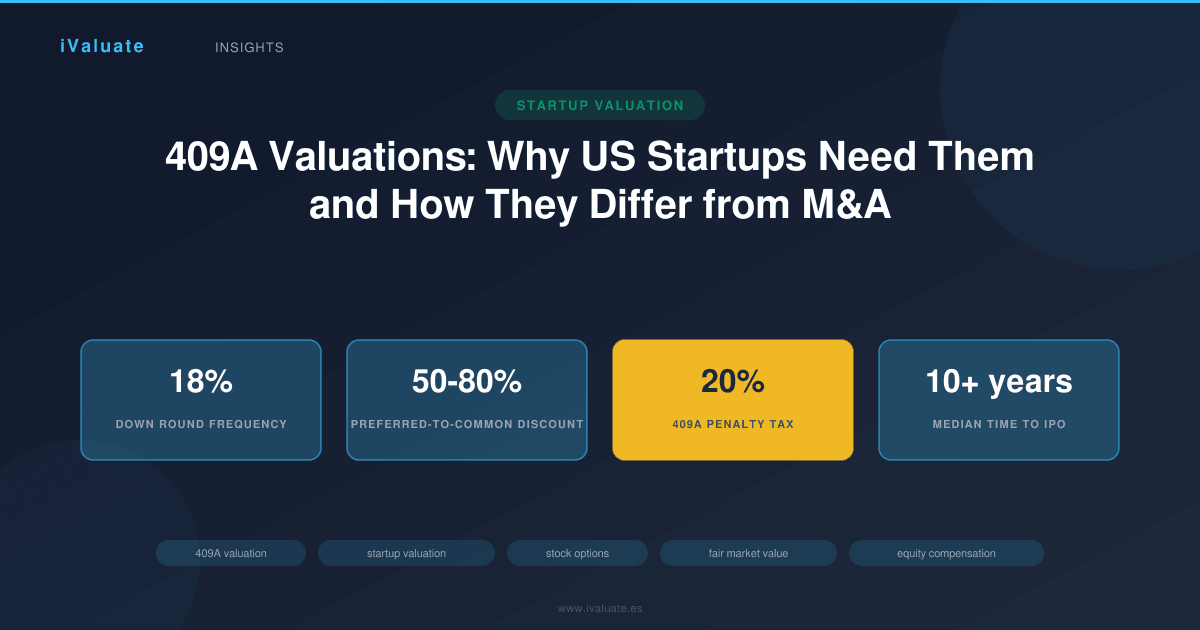
As we move through 2025-2026, the startup ecosystem has witnessed a recalibration following the exuberant valuations of 2021-2022. Down rounds have become more common, with approximately 18% of venture-backed companies experiencing valuation cuts in their latest funding rounds. This environment makes rigorous 409A valuations more important than ever, as the gap between preferred stock pricing (what investors pay) and common stock FMV (what employees receive) has widened considerably.
01 The Regulatory Foundation: Why 409A Valuations Exist
Section 409A was enacted in 2004 following corporate scandals where executives received backdated stock options, allowing them to profit from artificially low strike prices. The regulation requires that stock options be granted at or above the fair market value of the underlying common stock on the grant date. If options are granted below FMV, they're considered deferred compensation subject to immediate taxation plus a 20% penalty tax and interest charges.
The stakes are substantial. An employee receiving options with a strike price below FMV faces:
- Immediate income recognition on the spread between FMV and strike price
- A 20% additional federal tax penalty on that income
- Interest charges calculated from the date the option should have been taxed
- Potential state tax penalties in addition to federal consequences
For the company, the consequences include potential shareholder lawsuits, difficulties in future fundraising or exits, and reputational damage. The IRS provides a safe harbor: if a company obtains an independent 409A valuation and uses that FMV for option grants, the valuation is presumed reasonable unless the IRS can prove it was grossly unreasonable—a high bar to clear.
02 Fair Market Value: A Different Standard Than Transaction Value
The core distinction between 409A valuations and M&A valuations lies in what's being valued and for whom. A 409A valuation determines the per-share value of common stock in a hypothetical transaction between a willing buyer and willing seller, both having reasonable knowledge of relevant facts. This contrasts sharply with M&A valuations, which typically focus on enterprise value or the price a strategic or financial buyer would pay for the entire company or a controlling interest.
Consider a Series B startup that just raised $30 million at a $150 million post-money valuation. The preferred stock investors paid $15.00 per share. However, the common stock FMV for 409A purposes might be valued at $4.50 per share—a 70% discount. This isn't an error; it reflects fundamental differences in the rights, preferences, and marketability of preferred versus common stock.
Key Insight: The discount between preferred and common stock typically ranges from 50-80% for early-stage companies, narrowing to 20-40% for late-stage startups approaching IPO. The discount reflects liquidation preferences, anti-dilution protection, board control, and lack of marketability for common shares.
The Waterfall Analysis: Following the Money
The primary methodology distinguishing 409A valuations is the Option Pricing Method (OPM) or Probability-Weighted Expected Return Method (PWERM), both of which model how proceeds would be distributed to different share classes in various exit scenarios. This waterfall analysis accounts for:
- Liquidation preferences: Preferred shareholders typically receive 1x their investment before common shareholders receive anything
- Participation rights: Some preferred shares participate in remaining proceeds after receiving their preference
- Conversion features: Preferred stock converts to common in favorable scenarios (typically IPO or high-value acquisition)
- Anti-dilution protection: Weighted-average or full-ratchet provisions protecting preferred investors from down rounds
In a 2025 case study, a Series C SaaS company with $180 million in total capital raised and a $600 million preferred stock valuation received a 409A common stock valuation of $220 million—a 63% discount. The analysis modeled five scenarios ranging from a down-round acquisition at $150 million to an IPO at $1.2 billion. In three of the five scenarios, common shareholders received minimal or zero proceeds, justifying the substantial discount.
03 Methodological Approaches: The 409A Toolkit
While M&A valuations typically rely heavily on comparable company analysis and precedent transactions, 409A valuations employ a more structured hierarchy of methods based on the company's stage and available data.
Market Approach: When Recent Transactions Exist
For companies that have raised funding within the past 6-12 months, the most recent preferred stock financing provides a strong indication of enterprise value. However, the valuation specialist must still:
- Assess whether the transaction was arm's-length and involved sophisticated investors
- Consider any material changes in business performance or market conditions since the funding
- Apply appropriate discounts to derive common stock value from preferred stock pricing
- Evaluate any special terms (such as guaranteed returns or side letters) that might affect valuation
In the current market environment, the time elapsed since the last funding round carries particular weight. A company that raised at a $400 million valuation in Q2 2022 but has missed growth targets and faces a challenging fundraising environment in 2025 may require a 30-50% downward adjustment to enterprise value before even applying preferred-to-common discounts.
Income Approach: Discounted Cash Flow Analysis
For revenue-generating startups, particularly those in Series B and beyond, the income approach using discounted cash flow (DCF) methodology provides important validation. The 409A DCF differs from M&A DCF analysis in several ways:
- Discount rates: 409A valuations typically use higher discount rates (25-40% for early-stage, 18-25% for late-stage) reflecting the risk profile of common equity holders without preferred stock protections
- Probability adjustments: Projections may be probability-weighted to account for execution risk
- Terminal values: More conservative exit multiples reflecting the uncertainty of achieving projected scale
- Marketability discounts: Additional 20-30% discounts for lack of liquidity in private common stock
A fintech startup we analyzed in early 2025 projected $100 million in revenue by year five with 25% EBITDA margins. Using a 28% discount rate and a 5.0x revenue terminal multiple (compared to 8-10x for public comparables), the DCF yielded an enterprise value of $380 million. After applying a 25% marketability discount and allocating value through the OPM, common stock FMV was determined at $6.20 per share versus a preferred stock price of $18.50.
Asset Approach: For Pre-Revenue Companies
Seed-stage companies with minimal revenue often require the asset approach, which values the company based on the cost to recreate its technology, intellectual property, and assembled workforce. This method, while straightforward in concept, requires careful consideration of:
- Development costs for proprietary technology or software
- Value of regulatory approvals or licenses obtained
- Customer relationships and contracts in place
- Assembled workforce and organizational capital
The asset approach typically yields the lowest valuations and is often used as a floor value, cross-checked against market and income approaches when applicable.
04 The Option Pricing Method: Modeling Uncertainty
The OPM treats each class of stock as a call option on the enterprise value, with different strike prices based on liquidation preferences. Using Black-Scholes or binomial models, the methodology calculates the probability that enterprise value at exit will exceed various breakpoints where different share classes begin to receive value.
For a company with $50 million in Series A preferred stock with 1x liquidation preference and $30 million in common stock (on an as-converted basis), the OPM would model:
- Breakpoint 1 ($50M): Below this value, only preferred shareholders receive proceeds
- Breakpoint 2 ($80M): Above this value, preferred shareholders convert to common and all shareholders participate pro-rata
Using an estimated enterprise value of $120 million and volatility of 55% (typical for early-stage companies), the OPM might allocate 75% of equity value to preferred stock and 25% to common stock, despite common representing 37.5% of fully-diluted shares. This reflects the preferred stock's downside protection.
PWERM: Scenario-Based Modeling
The Probability-Weighted Expected Return Method takes a more explicit approach, modeling 3-5 specific exit scenarios with assigned probabilities and time horizons. A typical PWERM for a Series B company in 2025 might include:
- IPO scenario (20% probability, 4 years): $800M valuation, all shareholders participate pro-rata
- Strategic acquisition (35% probability, 3 years): $400M valuation, preferred receives liquidation preference then converts
- Down-round acquisition (25% probability, 2 years): $150M valuation, preferred receives all proceeds
- Dissolution (20% probability, 1.5 years): $30M in liquidation value, preferred receives all proceeds
Each scenario is modeled through the capitalization waterfall, and the resulting common stock values are probability-weighted and discounted to present value. PWERM is particularly useful when a company faces a near-term liquidity event or when market conditions create distinct possible outcomes.
05 How 409A Differs from M&A Valuation: A Direct Comparison
Understanding the distinctions between 409A and M&A valuations is essential for startup executives navigating both option grants and potential exits.
Purpose and Perspective
M&A valuations answer the question: "What would a buyer pay for this company?" They focus on enterprise value and typically consider synergies, strategic value, and control premiums. A strategic acquirer might pay 8-12x revenue for a high-growth SaaS company based on cross-selling opportunities, technology acquisition, or market consolidation benefits.
409A valuations answer: "What is a single common share worth in a hypothetical transaction?" They explicitly exclude control premiums and synergies, focusing on the value to a minority, non-controlling shareholder. The same SaaS company might have a common stock FMV implying only 3-4x revenue when accounting for preferred stock preferences and lack of marketability.
Methodological Emphasis
M&A valuations heavily weight:
- Comparable company trading multiples
- Precedent M&A transaction multiples
- Synergy value and strategic considerations
- Control premiums (typically 20-40% above minority interest value)
409A valuations emphasize:
- Allocation of value among share classes through OPM or PWERM
- Discounts for lack of marketability (20-30%)
- Probability-weighted scenarios reflecting execution risk
- Recent arm's-length preferred stock transactions as primary indicators
Discount Rate Considerations
M&A valuations typically use weighted-average cost of capital (WACC) in the 10-15% range for established companies, reflecting the blended cost of debt and equity for a diversified buyer. 409A valuations use equity discount rates of 20-45% depending on stage, reflecting the risk profile specifically of common equity holders without preferred stock protections or liquidity options.
Real-World Impact: In 2024-2025, we observed cases where companies acquired for $300-500 million had 409A common stock valuations just 6-12 months earlier of $80-150 million. This wasn't valuation malpractice—it reflected the fundamental difference between what a strategic buyer pays for control and what a minority common share is worth in isolation.
06 Timing and Frequency: When 409A Valuations Are Required
The IRS provides safe harbor if a 409A valuation is no more than 12 months old and no material events have occurred. However, best practice and investor expectations often drive more frequent updates:
- At incorporation: Initial valuation establishing baseline FMV (often minimal for pre-product companies)
- Before first option grants: Typically 3-6 months after incorporation when hiring begins
- After each funding round: New capital and valuation require updated 409A within 30-60 days
- Annually: Even without funding, annual updates maintain safe harbor protection
- Before material events: Significant product launches, customer wins, or business model changes may trigger updates
In the current market environment, companies should also consider interim updates if:
- Market comparables have declined significantly (as seen in 2022-2023)
- The company has missed projections materially
- A down round appears likely
- Acquisition discussions have begun (to ensure option grants don't create 409A issues)
07 The Cost of Getting It Wrong: Recent Enforcement Trends
While IRS enforcement of 409A violations has been relatively limited historically, recent trends suggest increased scrutiny. In 2024, the IRS announced enhanced focus on equity compensation compliance, particularly for companies that went public or were acquired in 2021-2023 at valuations substantially above their 409A valuations.
Consider a scenario that played out in 2024: A Series C company granted options at $8.00 per share based on an internal valuation in January 2022. The company was acquired in November 2022 for $450 million, implying a common stock value of approximately $22 per share at the acquisition date. The IRS challenged the $8.00 strike price, arguing that the company's rapid revenue growth and advanced acquisition discussions meant FMV was materially higher when options were granted.
The result: 147 employees faced amended tax returns, with an average additional tax liability of $43,000 per person including penalties and interest. The company faced shareholder litigation and had to establish a fund to partially compensate affected employees. The total cost exceeded $9 million—far more than the $25,000-40,000 cost of obtaining proper independent 409A valuations throughout the period.
08 Selecting a 409A Valuation Provider: What to Look For
Not all 409A valuations provide equal protection. The safe harbor requires an "independent appraisal," which means the valuation specialist must:
- Hold relevant credentials (ASA, CFA, ABV, or equivalent)
- Have no financial interest in the company beyond the valuation fee
- Perform a thorough analysis with documented methodology
- Issue a formal valuation report meeting professional standards
In 2025-2026, the market offers several tiers of 409A providers:
- Automated platforms ($1,000-3,000): Suitable for very early-stage, pre-revenue companies with simple cap tables
- Mid-tier firms ($5,000-15,000): Appropriate for Series A-B companies with straightforward structures
- Top-tier specialists ($15,000-40,000+): Necessary for complex cap tables, late-stage companies, or situations with heightened scrutiny risk
Red flags to avoid include providers who:
- Guarantee valuations at or near preferred stock prices
- Offer to "work backward" from a desired strike price
- Lack detailed documentation of methodology and assumptions
- Have no professional credentials or insurance
- Charge fees contingent on valuation outcomes
09 Looking Forward: 409A Valuations in a Maturing Ecosystem
As the startup ecosystem matures and the timeline to exit extends—with median time to IPO now exceeding 10 years for venture-backed companies—409A valuations have become more sophisticated and consequential. Several trends are shaping the landscape in 2025-2026:
Secondary market integration: With platforms like Forge and Nasdaq Private Market providing price discovery for private company shares, 409A valuations increasingly reference secondary transaction data. However, these transactions often involve information asymmetries and may not reflect true FMV, requiring careful analysis.
Down round complexity: The increase in down rounds (affecting 18% of funding rounds in 2024 versus 8% in 2021) creates challenging 409A scenarios. Companies must carefully model anti-dilution adjustments, pay-to-play provisions, and the impact on common stock value when preferred stock reprices.
Extended timelines: Companies remaining private longer face accumulating liquidation preferences that can exceed enterprise value in moderate exit scenarios. A Series E company with $500 million in total capital raised and 1x liquidation preferences might have common stock worth little unless exit value exceeds $600-700 million after accounting for option pool dilution.
Regulatory evolution: While 409A itself hasn't changed, IRS scrutiny has increased, particularly around the timing of valuations relative to material events. Companies should maintain contemporaneous documentation of business developments to support valuation dates and assumptions.
10 Practical Recommendations for Startup Leadership
Based on current market conditions and regulatory environment, startup executives should:
- Obtain independent 409A valuations early and regularly: Don't wait until you need to grant options. Have a current valuation in place before hiring begins.
- Update after material events: Significant funding rounds, product launches, or business model changes should trigger valuation updates even if less than 12 months have passed.
- Understand the methodology: Review the valuation report carefully and ensure you can explain the key assumptions and approaches to your board and employees.
- Budget appropriately: Plan for $5,000-15,000 per valuation for most Series A-B companies, with costs increasing for later stages and complexity.
- Maintain documentation: Keep detailed records of business developments, board discussions, and financial performance to support valuation timing and assumptions if questioned.
- Communicate transparently with employees: Help option recipients understand that strike price reflects common stock FMV, not company valuation, and explain the difference.
11 Conclusion: Valuation Rigor as Risk Management
409A valuations represent far more than a compliance checkbox for US startups. They're a critical risk management tool that protects both companies and employees from severe tax consequences while providing a disciplined framework for understanding value allocation across complex capital structures. The methodological differences from M&A valuations—particularly the focus on common stock value, application of OPM or PWERM, and substantial discounts for lack of marketability and preferred stock preferences—reflect fundamental economic realities that startup leaders must understand.
In today's environment, where down rounds have become more common and the path to exit has lengthened, rigorous 409A valuations matter more than ever. The gap between preferred and common stock value has widened, making it essential to work with qualified specialists who understand both the technical requirements and the practical implications of their work.
For companies navigating these complexities, professional platforms like iValuate provide the analytical tools and frameworks that valuation specialists rely on to perform thorough, defensible analyses efficiently. Whether you're a founder preparing for your first option grants, a CFO managing ongoing compliance, or an advisor guiding clients through funding and exit processes, understanding 409A valuation methodology isn't optional—it's essential to protecting value and avoiding costly mistakes in an increasingly sophisticated startup ecosystem.